
















Summary
Being a southpaw in Muay Thai is a genuine tactical advantage, and one that most fighters never fully exploit. Because the majority of opponents train and compete against orthodox fighters, the southpaw stance creates angles, openings, and timing mismatches that can disrupt even experienced fighters who have rarely faced a mirror-image opponent. But the advantage only materialises when it is paired with combinations and footwork specifically designed to capitalise on the southpaw position. This article covers what makes the southpaw stance unique, the structural advantages it provides, the key principles of footwork and positioning that maximise those advantages, and five practical Muay Thai combinations tailored specifically for southpaw fighters. Each combination is built around the southpaw’s structural strengths, the powerful lead right hand, the dominant outside angle, and the rear left kick that lands where orthodox fighters are least prepared to defend. As Muay Thai World Champion and Evolve MMA instructor Chaowalit Jocky Gym puts it, “A southpaw who understands their angles is a nightmare to fight. The combinations come from places orthodox fighters are not trained to see, and by the time they adjust, you have already landed and moved. The stance is a gift — but only if you know how to use it.” Whether you are a natural southpaw developing your combination game or a coach working with southpaw students at a gym like Evolve MMA in Singapore, this guide gives you the framework to turn stance into strategic dominance.
Key Takeaways
- The southpaw advantage is real, but only activates with the right footwork and positioning. Simply standing southpaw does not guarantee disruption; the advantage comes from actively placing your lead foot to the outside of your opponent’s lead foot, which shortens your strike path and lengthens theirs simultaneously.
- The lead right hand is the southpaw’s most underestimated weapon. In an orthodox fighter, the lead left hand is the weaker jab hand. As a southpaw, your lead hand is typically your power hand, meaning your jab carries significantly more threat than your opponent expects, and your lead hook can be a genuine finishing strike.
- Southpaw combinations are most effective when built around the rear left kick. The southpaw’s rear left kick travels across an orthodox opponent’s body from a direction they face less frequently in sparring, landing on the right side of their ribs or head — areas that are structurally harder to defend against a kick coming from that angle.
- Circling to the right is the southpaw’s directional priority. Moving to the right places you outside of an orthodox opponent’s lead leg, the dominant southpaw position, while moving to the left takes you into the path of their strongest weapons. Ingraining this directional preference into your footwork habits is one of the most important adjustments a southpaw can make.
- Unpredictability is a structural feature of the southpaw stance, not just a byproduct of skill. Most orthodox fighters have dramatically less sparring experience against southpaws than against other orthodox fighters. This means the timing, angles, and attack patterns of a southpaw combination are genuinely unfamiliar — an advantage that compounds the longer a fight lasts and the more a specific combination is set up and repeated.
- The same combinations that work for orthodox fighters work for southpaws — but the targets and the angles are different. A jab-cross-hook-low kick combination lands on different sides of the opponent’s body depending on stance, hits different structural targets, and requires different defensive responses. Understanding these differences is what allows a southpaw to use familiar combinations with maximum effectiveness.
What Makes A Southpaw Unique
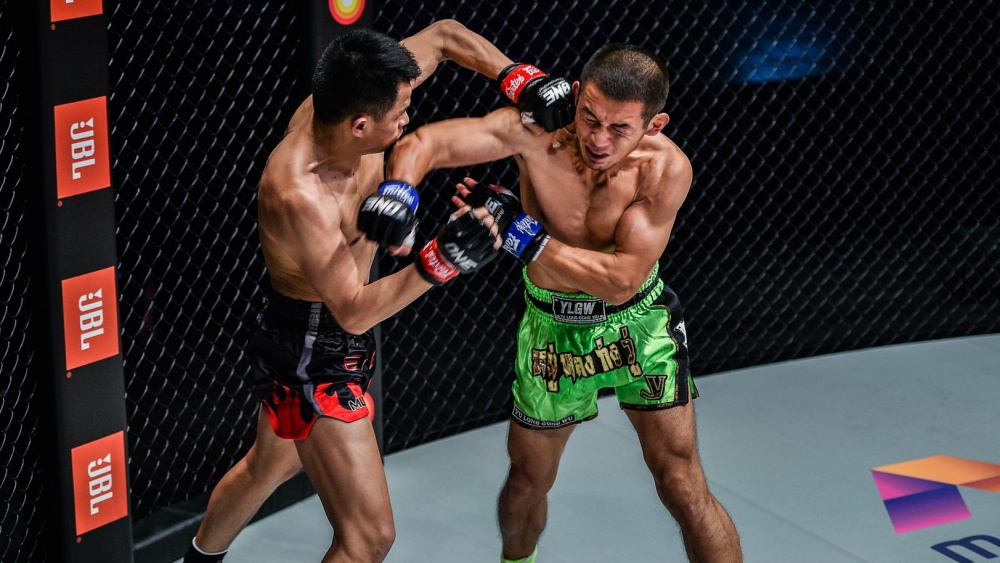
In Muay Thai, the difference between a southpaw combination and an orthodox combination lies in the stance and positioning of the fighters. Here are the primary distinctions:
- Stance: Southpaw fighters stand with their right foot forward and left foot back, while orthodox fighters have their left foot forward and right foot back. This difference in stance fundamentally alters the positioning and angles of attack for each fighter.
- Lead Hand: In an orthodox combination, the lead hand is the left hand, while in a southpaw combination, the lead hand is the right hand. This means that the lead right hand is used more frequently in southpaw combinations, while orthodox combinations typically rely more on the lead left hand.
- Angles Of Attack: Due to the opposite stances, the angles of attack and defence differ between southpaw and orthodox fighters. For example, a southpaw fighter’s rear hand (left hand) will have a clearer path to the opponent’s centreline, whereas an orthodox fighter’s lead hand (right hand) will have a more direct line of attack.
- Setups And Footwork: Southpaw fighters often have specific setups and footwork patterns designed to capitalise on their stance. They may focus on circling to their right to gain an advantageous angle, while orthodox fighters might emphasise circling to their left.
- Counterattacks: Counter-attacking strategies can also differ between southpaw and orthodox fighters. A southpaw fighter may tend to counter with their lead hand, while an orthodox fighter may rely more on counters with their rear hand.
It’s important to note that these differences are not absolute, and individual fighters may have their own preferences and variations. Ultimately, the effectiveness of combinations depends on the skill, technique, and adaptability of the fighter, regardless of their stance.
Advantages Of Being A Southpaw Fighter
- Unfamiliarity: Most fighters are orthodox, making the southpaw stance less common. This unfamiliarity can work to your advantage, catching opponents off-guard and disrupting their timing and angles.
- Powerful Lead Hand: As a southpaw, your lead hand is your right hand, often your power hand. This allows you to throw potent jabs and hooks with your lead hand, unsettling opponents with unexpected power.
- Enhanced Footwork: Due to the relative scarcity of southpaw opponents, your footwork may be more refined than that of orthodox fighters. This agility and adaptability provide you with an edge in movement and positioning during exchanges.
- Expanded Angles: With your lead hand on the opposite side of your body compared to orthodox fighters, you have access to a wider array of angles for punches and kicks, opening up unique opportunities to exploit your opponent’s defences.
- Unpredictability: The reversal of stance and punches can make southpaw fighters more unpredictable to orthodox opponents, adding an element of surprise to your attacks and making it challenging for opponents to effectively defend against your strikes.
Mastering Southpaw Combinations
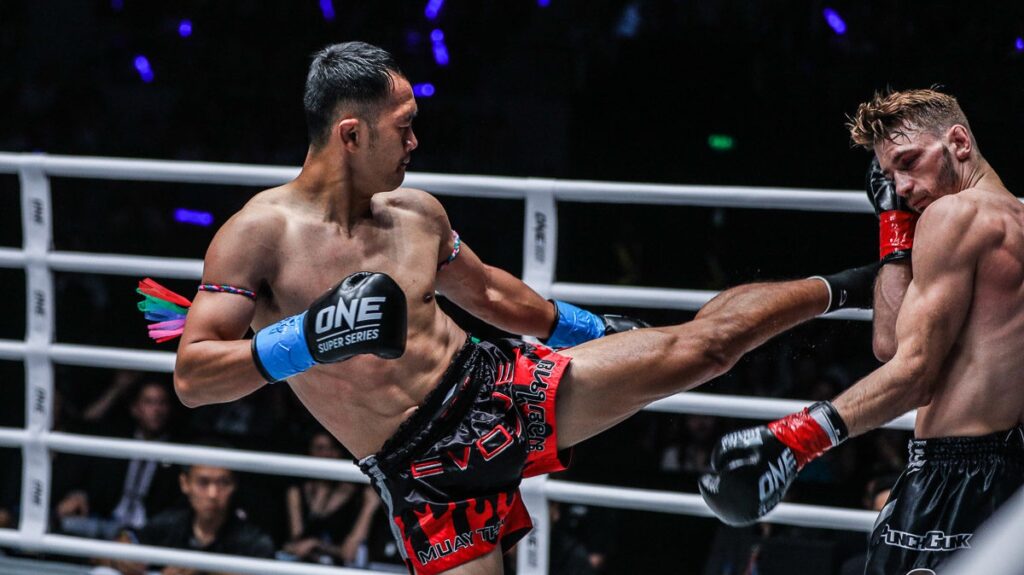
To maximise your effectiveness as a southpaw fighter, it is essential to develop and execute combinations suited to your stance and fighting style. Here are some key considerations:
- Positioning: Aim to position yourself to the outside of your opponent’s lead leg, aligning your rear shoulder and rear foot with their centreline. This alignment shortens the path of your strikes, increasing speed and power.
- Angles And Footwork: Capitalise on your ability to create angles by pivoting or circling to your right. This can place you in a dominant position, similar to getting behind your opponent.
5 Effective Muay Thai Southpaw Combinations
- Jab, Cross, Hook, Low Kick: Target your opponent’s head with a jab and cross before delivering a hook to the body. Finally, follow up with a powerful low kick to the legs.
- Jab, Cross, Hook, Uppercut: Employ this combination to penetrate your opponent’s guard, launching strikes to their head and body with a focus on generating power through the uppercut.
- Jab, Cross, Left Hook, Left Body Kick: Begin with a standard jab and cross, then transition smoothly into a left hook to the head. Conclude the combination with a forceful body kick.
- Jab, Cross, Lead Teep: This combination excels at maintaining distance and dictating the fight’s pace. Use the jab and cross to set up a lead teep (push kick) to control your opponent’s forward movement.
- Jab, Cross, Lead Hook, Rear Kick: Start with a jab and cross, then follow up with a lead hook to the head or body. Finish the combination by delivering a powerful rear kick.
Frequently Asked Questions About Southpaw Muay Thai Combinations
Q: Why Is The Southpaw Vs Orthodox Matchup Considered So Challenging For Orthodox Fighters?
A: The southpaw vs orthodox matchup is structurally asymmetrical in ways that disadvantage the orthodox fighter. The lead hands and lead legs of both fighters are on opposite sides, which means the angles of attack, the path of incoming strikes, and the positions of the openings are all mirrored from what an orthodox fighter has trained against in the vast majority of their sparring. The southpaw’s rear left cross travels to the orthodox fighter’s open side, the side their guard is weaker on, while the orthodox fighter’s rear right cross travels to the southpaw’s stronger defensive side. Most orthodox fighters simply have far less sparring experience against southpaws, making the timing and distance management of the matchup genuinely unfamiliar regardless of their overall skill level.
Q: What Is The Most Important Footwork Habit A Southpaw Should Develop?
A: Consistently circling to the right is the single most important directional habit a southpaw can develop against orthodox opponents. Moving to the right takes you to the outside of your opponent’s lead leg — the dominant southpaw position where your strikes have a clear path, and their counters are compromised. Moving to the left, by contrast, takes you directly into the path of their rear right hand, which is their most powerful weapon. Making right-side circling automatic — through deliberate footwork drilling and conscious attention in sparring — is the foundation that makes every other southpaw advantage accessible.
Q: How Should A Southpaw Use The Lead Right Hand Differently From An Orthodox Fighter’s Lead Left Hand?
A: An orthodox fighter’s jab is typically their weaker hand — fast but not particularly powerful, used primarily for range finding and combination setup. A southpaw’s lead right hand is usually their power hand, which means the jab carries a genuine finishing threat that orthodox opponents are not conditioned to respect in the way they respect an incoming cross. Southpaws should exploit this by throwing the lead right hand with more intent and power than a typical jab, using it not just as a setup tool but as a genuine scoring and finishing weapon. The lead right hook, in particular, is one of the southpaw’s most dangerous tools — arriving from an angle that orthodox fighters see rarely and defend poorly.
Q: How Does The Rear Left Kick Differ In Effect For A Southpaw Compared To An Orthodox Right Kick?
A: The southpaw’s rear left kick travels across an orthodox opponent’s body from right to left — landing on the right side of their ribs, liver, or head. This is a direction that orthodox fighters defend significantly less often in training, because the vast majority of their sparring partners are orthodox and kick from the opposite side. As a result, the southpaw’s rear left body kick in particular tends to land on the liver side with high frequency and without the automatic defensive adjustment that an orthodox body kick would trigger. Over the course of a fight, this positional disadvantage for the orthodox fighter compounds — the rib and liver area on their right side takes repeated damage from a kick they are structurally less prepared to check or block.
Q: How Do I Set Up The Combinations In This Article Most Effectively In Sparring?
A: Each combination in this article begins with a jab-cross entry, and the effectiveness of the finishing strike depends on the entry having been established as a credible threat. The first few rounds of any fight or sparring session should involve throwing the jab-cross repeatedly — not to finish the opponent, but to condition them to defend the head, raise their guard, and focus their attention forward. Once that defensive pattern is established, the finishing strikes in each combination — the low kick, the uppercut, the body kick, the teep, the rear kick — all land more cleanly because the opponent’s guard and attention have been directed away from them. Establishing the jab-cross early is the investment that pays off in the finishing strikes later.
Q: Should A Southpaw Try To Adjust Their Combinations When Facing Another Southpaw?
A: Yes — the structural advantages of the southpaw stance against orthodox opponents largely disappear in a southpaw vs southpaw matchup, because both fighters face the same angles and have the same footwork tendencies. Against another southpaw, the lead hand advantage equalises, the directional footwork priority shifts, and the combinations that exploit the orthodox fighter’s open side no longer have the same effect. Southpaw fighters who have trained primarily against orthodox opponents often find southpaw vs southpaw matchups surprisingly difficult for exactly this reason. The adjustment involves rethinking footwork direction, lead hand usage, and the specific targets that the rear kick and hook are most naturally aimed at in a mirrored stance configuration.
Q: How Many Southpaw-Specific Combinations Should I Focus On Developing?
A: Three to five combinations drilled to a high standard is significantly more useful than a broad but shallow knowledge of many sequences. The five combinations in this article cover the full range of southpaw tactical situations — distance control, power entries, body attack setups, and rear kick finishers — so mastering them gives you a complete toolkit for most sparring and competitive contexts. The process is the same as for any combination work: drill each sequence slowly in shadowboxing until the transitions are clean, develop power and timing on the heavy bag, and test them in sparring against orthodox partners specifically. The southpaw combinations in this article are particularly worth drilling at Evolve MMA in Singapore, where the diversity of sparring partners means you can test them against a wide range of orthodox styles and reactions.
Q: Can An Orthodox Fighter Benefit From Learning Southpaw Combinations?
A: Yes — for two reasons. First, understanding how southpaw combinations work and what makes them tactically effective makes you significantly better at defending against them, because you understand the angles and setups that precede the attacks rather than simply reacting to the strikes as they arrive. Second, developing even a basic ability to switch to southpaw and execute one or two combinations — as covered in switch-hitting articles — gives you an additional layer of unpredictability that purely orthodox fighters cannot access. You do not need to fight southpaw fluently to benefit from occasional stance switches; you only need a small number of clean southpaw combinations to make the switch a genuine tactical threat rather than just a movement pattern.
Final Thoughts
The southpaw advantage in Muay Thai is real, structural, and available to any fighter willing to develop the footwork, positioning habits, and combination vocabulary to activate it. The unfamiliarity you create for orthodox opponents does not require exceptional athleticism or years of advanced training — it is a product of standing differently and understanding how that difference changes every angle in the fight.
The five combinations in this article give you a practical starting point that covers the full tactical range of southpaw striking: power entries, distance control, body attack setups, and rear kick finishers. Drill them with the footwork principles outlined in this article — right-side circling, outside lead foot positioning, rear shoulder alignment — and the combinations will land with a clarity and frequency that reflects not just technical skill but genuine strategic advantage.
You may also like:
4 Muay Thai Footwork Drills For Beginners

Summary Footwork is the foundation that every other skill in Muay Thai is built on. Without the ability to move into striking range, out of danger, and onto advantageous angles, even the most powerful and…
Summary The switch step is one of the most versatile and underutilised footwork movements in Muay Thai — a single, fluid action that unlocks kicks, knees, and punches from entirely new angles while simultaneously moving…
Summary Age is not the barrier most people assume it is when it comes to starting Muay Thai. People in their 40s, 50s, and 60s train the art of eight limbs all over the world…
Summary Muay Thai is one of the most rewarding martial arts you can train in — and one of the most demanding to develop genuine competence in. The path from complete beginner to confident, well-rounded…
Summary Stepping into sparring with a training partner who is significantly larger than you is one of the most instructive and most intimidating experiences in Muay Thai. The size and strength advantage your opponent carries…
Summary The spear knee, also known as the straight knee, is one of the first knee techniques taught in Muay Thai and one of the most important to master. Driven forward with hip power and…
Summary Switch-hitting, the ability to seamlessly change stance mid-fight, is one of the rarest and most tactically disruptive skills in Muay Thai. When executed correctly, it forces opponents to process strikes coming from unfamiliar angles,…
Summary Sparring is one of the most valuable tools in Muay Thai training, and one of the easiest to misuse. Done correctly, it accelerates technical development, builds fight-ready timing, and creates the kind of pressure-tested…
Summary Learning combinations is one of the most important steps in developing effective striking in Muay Thai and kickboxing. A single well-placed strike can score, but a well-constructed combination, one that attacks multiple levels, creates…
Summary Muay Thai‘s power as a striking system lies not in the complexity of its techniques, but in the seamless way those techniques combine. A jab sets up a cross, a cross sets up a…
Summary The teep , Muay Thai‘s push kick, is often introduced to beginners as a distance control tool, but its true value is revealed when you learn to chain it into combinations. Used in isolation,…
Summary The teep, also known as the push kick, is one of Muay Thai’s most fundamental and frequently used techniques. Functionally, the kicking equivalent of the jab, it controls distance, disrupts rhythm, sets up combinations,…