














Summary
Footwork is the foundation that every other skill in Muay Thai is built on. Without the ability to move into striking range, out of danger, and onto advantageous angles, even the most powerful and technically refined techniques become unreliable because the fighter is never quite in the right position to use them. This article covers four essential Muay Thai footwork drills that every beginner should drill from their very first weeks of training: straight-line movement in all four directions, cutting angles to create offensive positions, circling away to reset defensively, and applying both to the heavy bag. Each drill is broken down step by step, with partner variations that build the reactive, pressure-tested footwork that bag work alone cannot develop. As Muay Thai World Champion and Evolve MMA instructor Chaowalit Jocky Gym puts it, “Footwork is invisible to most beginners — they focus on the punch, the kick, the elbow — but the fighters who improve fastest are always the ones who understand that the movement comes first. If you are in the right place, the strike is easy. If you are in the wrong place, no technique in the world will save you.” Whether you are training at a gym like Evolve MMA in Singapore or working on your own, these four drills give you everything you need to build the footwork foundation that the rest of your Muay Thai game depends on.
Key Takeaways
- Footwork is the most important fundamental in Muay Thai and the one most beginners neglect. Without reliable movement, striking and defensive techniques cannot be applied consistently, because execution depends entirely on being in the right position at the right moment.
- Straight-line movement must be mastered before anything else. The ability to move forward, backward, left, and right in rhythm, without compromising your base, crossing your feet, or shifting your weight so far that you cannot change direction quickly, is the non-negotiable prerequisite for every other footwork pattern.
- Moving off the centreline is what creates genuine offensive advantages. Stepping to a 45-degree angle and pivoting puts you beside your opponent rather than directly in front of them, exposing their body to your attacks while moving you outside the path of their most powerful weapons.
- Circling away is preferable to moving straight back under pressure. Retreating in a straight line surrenders the centre of the ring and leads predictably to the ropes. Circling away, particularly away from your opponent’s power side, resets your position while maintaining ring control.
- Heavy bag footwork bridges the gap between isolated drills and live application. Using the bag as a moving obstacle to step around, cut angles on, and retreat from trains, the coordination between your movement and your striking in a way that shadowboxing alone cannot replicate.
- Partner drills are essential for developing reactive footwork. Footwork practiced only in isolation produces movement that is smooth in rehearsal and stiff under pressure. Partner variations — mirroring, reacting to called directions, and responding to an advancing opponent — develop the adaptive quality that makes footwork work in sparring.
Drill #1 – Moving In A Straight Line
Before you do anything else, you need to know how to go forward, back, left, and right in order to establish good Muay Thai footwork.
It’s key to move in rhythm, and in a way that allows you to maintain your base. That means you’ll be stable and balanced so you can strike, defend, and change direction without making a big adjustment.
Before you even take a step, make sure you’re set in your stance, your knees are slightly bent, and your weight is central as you move on the balls of your feet.
- Move forward by stepping with your left foot first. When it touches the mat, move your right foot the same distance. Your feet should be the same distance apart as when you started.
- Move back by stepping with your rear foot first, then bring your left foot behind it.
- Move right by moving your right foot first. Again, your left foot should follow.
- Move left in the same way – this time, it’s left foot first, and the right will follow.
That’s all there is to this drill. Take a few steps one way and then another, and repeat – over and over again.
Admittedly, this is not a fun drill. However, if you devote time to practicing this, it will be the perfect foundation for your entire Muay Thai skillset.
Work With A Partner: There are two ways to bring an additional element to this drill.
First, you can get a training partner to call out directions. If you don’t know what’s coming, you’ll have to react and adjust on the fly. This will really test if you are shifting your weight too much to change direction quickly.
The second way is to mirror a partner’s movement. Stand opposite them and follow their lead. If they step back, you go forward. If they move left, go right to stay in front of them.
Drill #2: Cut An Angle
Now for a way to move into an attacking position.
By moving off the centerline, you’ll be able to create angles and come at your opponent in a way that will make them much more vulnerable.
To move off to the left:
- Step forward and out at a 45-degree angle with your left foot.
- Pivot on your front foot and turn to the right by moving your right foot behind you in a clockwise direction.
- Land with your right foot back in an orthodox stance.
To move off to the right:
- Step forward and out with your right foot. This step should be slightly further than when you step to your left, but don’t go too far and lose balance.
- Pivot on your right foot and turn to your left by moving your left leg anticlockwise.
- Land with your left foot back, in a southpaw stance.
Work With A Partner: This is a great technique to use against an aggressive opponent that comes forward a lot. Have your teammate walk forward so you can slip around them and emerge to the side of them.
Drill #3: Circle Away
Time to switch things up to do some defensive work.
If you don’t fight fire with fire against an aggressive opponent, your best bet is to move away so you can reset and set up a new plan of attack.
You can step back, but it’s best to avoid moving back in a straight line because you’ll soon run out of ring and end up in a bad position, against the ropes.
There are two ways to circle away, and it may depend on your opponent
- To circle to your left, take a step straight back, first.
- Once you have created some distance, start stepping to your left along a circular track.
It’s difficult to move diagonally back to your left without crossing your legs or compromising your Muay Thai defense, so it’s best to create that space and then move away.
This is best against a southpaw. You almost always want to move away from your rival’s power. That’s the left side of an orthodox fighter, so move to their right.
Against an orthodox opponent, you’ll want to move away from their right side, so that’s to your right.
You can still step straight back, but you can also move backward and laterally at the same time.
- Start to move back and to the right by stepping diagonally back, right foot first.
- Continue to move laterally, around where your opponent would be.
Work With A Partner: Similar to cutting an angle, this works best against an aggressive opponent. Get your teammate to come at you, and force them to follow you as you circle around 180 degrees to face where you started.
Drill #4 – Heavy Bag
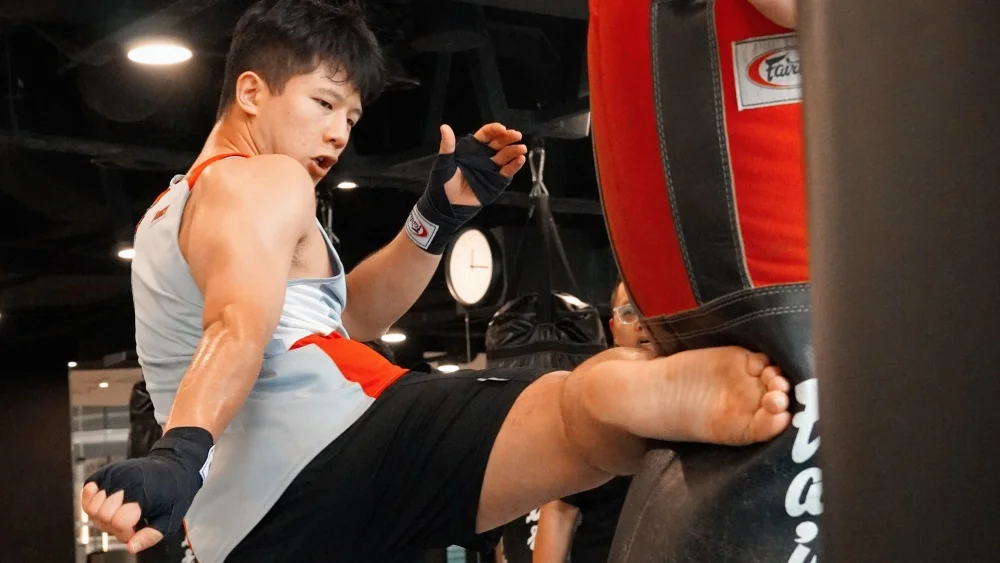
Now you can use what you’ve learned on the heavy bag.
- Stay on the balls of your feet as you step toward the bag, away from it, and laterally around it.
- Lead with the outside leg as you move laterally, your front leg when you move forward, and your back leg when you move back.
- Maintain your balance as your shift your weight and don’t cross your feet.
- Once you’re comfortable moving your feet smoothly, you can start to strike the bag.
- Try to cut some angles on the bag and circle around it – particularly when it swings toward you.
Frequently Asked Questions About Muay Thai Footwork
Q: Why Is Footwork Considered The Most Important Fundamental In Muay Thai?
A: Every offensive and defensive technique in Muay Thai depends on being in the correct position to execute it. A teep thrown from the wrong range misses or loses all its power. A roundhouse kick thrown without the correct base is easy to catch. A defensive check requires being balanced enough to lift the leg cleanly. Footwork is what puts you in the position where every other technique works — and takes you out of the position where your opponent’s techniques land. Fighters who neglect footwork in favour of striking development reach a ceiling relatively quickly, because their technically sound strikes keep failing in sparring due to positioning errors that footwork would have prevented.
Q: How Long Should I Spend Drilling Straight-Line Movement Before Moving To More Complex Footwork?
A: There is no fixed timeline, but the benchmark is functional rather than time-based: you are ready to move to angle-cutting and circling drills when your straight-line movement feels natural and automatic — when you can move in any direction without consciously thinking about which foot leads, without crossing your feet, and without losing your base. For most beginners training consistently, this takes a few weeks of deliberate drilling. Rushing to more complex footwork patterns before straight-line movement is solid produces a shaky foundation that limits every pattern built on top of it. Return to straight-line movement drills throughout your training — even experienced fighters benefit from revisiting the fundamentals to identify and correct drift in their movement habits.
Q: What Does It Mean To Stay On The Balls Of Your Feet And Why Does It Matter?
A: Staying on the balls of your feet means keeping your heels light — not fully raised, but not flat on the floor either. This position keeps your weight forward and your balance dynamic, allowing you to change direction, step, or spring into a strike with minimal preparation movement. A fighter whose weight is back on their heels is effectively anchored — they need an additional weight shift before they can move in any direction, which costs time and creates a visible tell. It also makes them significantly harder to sweep, as their weight cannot be easily leveraged. Training the habit of staying light on the balls of your feet from your very first sessions is one of the most valuable investments you can make in your long-term movement quality.
Q: What Is The Difference Between Cutting An Angle And Circling Away, And When Should I Use Each?
A: Cutting an angle is primarily an offensive movement — you step off the centreline to position yourself beside your opponent, making them vulnerable to your attacks while placing you outside the direct path of their counters. It is most useful when you want to create a striking opportunity or neutralise a forward-moving opponent. Circling away is primarily a defensive and reset movement — you move away from your opponent’s power side to create distance, maintain ring control, and set up your next sequence. It is most useful when you are under pressure, have been backed toward the ropes, or need time to reset after a defensive exchange. In practice, the two movements often flow into each other: circling away to reset, then cutting an angle to re-engage offensively.
Q: Why Should I Avoid Moving Straight Back When Under Pressure?
A: Moving straight back surrenders the centre of the ring progressively — and the centre of the ring is where footwork advantages are maximised and ring space is most available. A fighter who consistently retreats in straight lines will eventually find themselves against the ropes, where their circling options are eliminated and their opponent can attack without concern for being flanked or outmanoeuvred. Straight backward movement also keeps you directly in front of your opponent’s power weapons throughout the retreat, which is the least safe position to be in when under pressure. Circling away — particularly away from their dominant hand — resets your position while staying out of the most dangerous counter range.
Q: How Do I Use The Heavy Bag To Improve My Footwork Rather Than Just My Striking?
A: Treat the bag as a moving opponent rather than a stationary target. Focus your rounds specifically on movement — stepping in to strike and immediately stepping out or to an angle, circling the bag continuously while staying on the balls of your feet, and using the bag’s swing as an incoming attack to circle or step away from. Mark specific spots on the floor or use the bag’s position to practise cutting to specific angles. Dedicated footwork-focused rounds on the bag, where the goal is quality of movement rather than power of striking, develop the coordination between your feet and your hands that does not develop when striking is always the primary focus. At a gym like Evolve MMA in Singapore, coaches will often structure bag rounds with specific movement objectives for exactly this reason.
Q: How Does Partner Footwork Drilling Differ From Solo Drilling, And Why Do I Need Both?
A: Solo drilling — shadowboxing, bag work, and footwork patterns practised alone — builds the movement patterns into your muscle memory and develops the coordination and balance required to execute them consistently. Partner drilling adds the element that solo work cannot provide: reaction. When a training partner calls directions, mirrors your movement, or advances toward you, your footwork must respond to something unpredictable rather than something you have chosen. This reactive quality is what makes footwork functional in sparring and competition, and it cannot be developed without another person. Both methods are necessary: solo drilling builds the foundation, and partner drilling builds the adaptability that makes the foundation useful under pressure.
Q: How Soon Should Beginners Start Incorporating Footwork Into Sparring?
A: From the very first sparring session. Footwork is not a prerequisite you complete before sparring — it is a skill you develop through sparring, alongside your striking and defensive development. The key is to bring a deliberate footwork intention into every sparring round rather than allowing movement to become purely reactive and unconscious. Choosing a specific footwork objective for a round — circle away from the power hand, cut an angle after every jab, stay off the centreline — keeps your attention on movement even when the natural instinct is to focus entirely on the exchange of strikes. Over time, this deliberate practice accumulates into movement habits that become automatic, which is exactly the goal.
Final Thoughts
Footwork is the skill that ties everything together in Muay Thai — and the one that most beginners underinvest in during the early months of training. It is less immediately satisfying to drill than striking, less visceral than sparring, and less obviously productive than pad work. But the fighters who build strong footwork foundations early develop faster, plateau less often, and perform more consistently under pressure than those who treat movement as secondary to technique.
The four drills in this article are the starting point. Straight-line movement gives you the base. Angle-cutting gives you the offensive positions. Circling away gives you the defensive reset. The heavy bag ties it all together with resistance and timing. Master these four patterns, and you will have the footwork vocabulary to begin building everything else — combinations that flow from better positions, defensive responses that come from better angles, and the ring control that makes your entire game more difficult to solve. Start with drill one. Do it more than feels necessary. The investment will show in every other aspect of your training.
You may also like:
What Is The Switch Step In Muay Thai

Summary The switch step is one of the most versatile and underutilised footwork movements in Muay Thai — a single, fluid action that unlocks kicks, knees, and punches from entirely new angles while simultaneously moving…
Summary Age is not the barrier most people assume it is when it comes to starting Muay Thai. People in their 40s, 50s, and 60s train the art of eight limbs all over the world…
Summary Muay Thai is one of the most rewarding martial arts you can train in — and one of the most demanding to develop genuine competence in. The path from complete beginner to confident, well-rounded…
Summary Switch-hitting, the ability to seamlessly change stance mid-fight, is one of the rarest and most tactically disruptive skills in Muay Thai. When executed correctly, it forces opponents to process strikes coming from unfamiliar angles,…
Summary Stepping into sparring with a training partner who is significantly larger than you is one of the most instructive and most intimidating experiences in Muay Thai. The size and strength advantage your opponent carries…
Summary Sparring is one of the most valuable tools in Muay Thai training, and one of the easiest to misuse. Done correctly, it accelerates technical development, builds fight-ready timing, and creates the kind of pressure-tested…
Summary Learning combinations is one of the most important steps in developing effective striking in Muay Thai and kickboxing. A single well-placed strike can score, but a well-constructed combination, one that attacks multiple levels, creates…
Summary Muay Thai‘s power as a striking system lies not in the complexity of its techniques, but in the seamless way those techniques combine. A jab sets up a cross, a cross sets up a…
Summary The teep , Muay Thai‘s push kick, is often introduced to beginners as a distance control tool, but its true value is revealed when you learn to chain it into combinations. Used in isolation,…
Summary The teep, also known as the push kick, is one of Muay Thai’s most fundamental and frequently used techniques. Functionally, the kicking equivalent of the jab, it controls distance, disrupts rhythm, sets up combinations,…
Summary The spear knee, also known as the straight knee, is one of the first knee techniques taught in Muay Thai and one of the most important to master. Driven forward with hip power and…
Summary The knee guard is one of Muay Thai‘s most intelligent and underappreciated techniques, a transitional move that transforms the moment immediately after a knee strike from a moment of vulnerability into a position of…