

















Summary
The spear knee, also known as the straight knee, is one of the first knee techniques taught in Muay Thai and one of the most important to master. Driven forward with hip power and precision, it is designed to punish opponents at mid-range and break them down in the clinch, making it a weapon that functions effectively in multiple positions and fight scenarios. This article covers everything you need to develop a dangerous spear knee: the correct stance and step-in mechanics, the full sequence of body positions required for maximum power, how to execute the technique from the clinch, the most common mistakes that rob the strike of its effectiveness, and the corrections that fix them. Whether you are drilling on the heavy bag, working with a training partner, or refining your clinch game in live sparring, the spear knee is a technique that rewards careful, deliberate practice. As Muay Thai World Champion and Evolve MMA instructor Chaowalit Jocky Gym puts it, “The spear knee is not just a power strike — it is a fight-changer. Land it clean to the body in the clinch, and your opponent’s whole game begins to fall apart. It takes the breath, the confidence, and the will to keep fighting.” If you train at a gym like Evolve MMA in Singapore, your coaches will return to this technique repeatedly because when it is thrown correctly, very few strikes in Muay Thai are more damaging.
Key Takeaways
- The spear knee is a short-to-mid-range weapon that can also be thrown at long range and as a switch knee. Understanding all three variations gives you the flexibility to deploy it from multiple distances and positions, making it significantly harder for opponents to anticipate.
- Hip drive is the engine of the spear knee. The power of the strike does not come from the leg alone — it comes from thrusting the hips forward as the knee travels toward the target. Without full hip extension, the strike loses the majority of its impact.
- The step forward is non-negotiable. Failing to take a small step before throwing the knee is the most common beginner mistake. The step closes the distance, creates the right angle, and generates the forward momentum that the hip drive then converts into power.
- The spear knee is equally effective as a standalone strike and as a clinch weapon. From the clinch, a dominant arm position allows you to pull your opponent into the knee rather than simply driving toward them — multiplying the force of impact and making the strike significantly harder to avoid.
- Foot position and alignment are precision details that separate effective spear knees from weak ones. Pointing the foot, flexing the back foot into a straight line through the instep, and lining the knee up with the target are small technical details that have a large impact on both power and accuracy.
- The spear knee is as much a conditioning weapon as it is a finishing one. Repeated clean spear knees to the body accumulate damage over rounds, breaking down an opponent’s core, disrupting their breathing, and gradually eroding their ability to fight at their natural pace.
What Is The Spear Knee
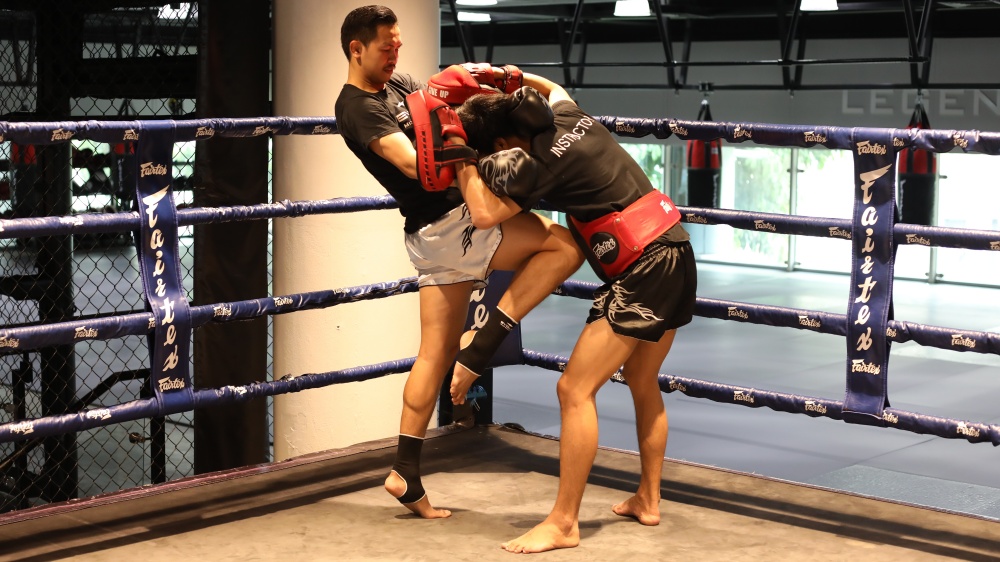
What the Spear Knee should look like:
- Begin in a fighting stance with your feet shoulder-width apart and your weight evenly distributed.
- Take a small step forward and slightly out with your front leg.
- Push off the ball of your lead foot to drive your knee up and forward.
- Flex your back foot to create a straight line from your shin down through your instep.
- Tuck your heel toward your backside to flex your knee, ensuring maximum impact on your target.
- Drive your hips forward to generate the most power, while leaning back to keep your head out of harm’s way.
- Use your rear arm as a long guard or grab your opponent’s head for added stability and to break their posture.
- Protect your head with your lead hand.
- Step back into your stance.
This basic technique can be used in three positions. The spear knee is considered a short to mid-range attack, but there is also a long-knee version. You can also throw this knee with a switch-knee move.
There are two ways you can execute the Muay Thai spear knee. One is by waiting for the opponent’s arm guards to open up and then driving the spear into their midsection, and the other is working this technique from the clinch position.
Muay Thai Spear Knee From The Clinch
In and of itself the clinch is a fight for dominance. You are working to control the opponent’s head or body position to deliver punishing strikes. Grappling for the right position while setting up for a strike.
Once you have established a dominant position, possibly with one hand behind the neck and the other on the forearm, this is the time when you can deliver a spear knee to your opponent’s midsection.
The arm positions while in the clinch can vary but the execution of the spear knee will fundamentally remain the same.
The execution of the Muay Thai spear knee from the clinch:
- Begin by securing a dominant clinch position with your arms around your opponent’s neck and under their arms.
- Use your elbows to create space between you and your opponent, allowing you to move your hips back and create room for the knee strike.
- Lift your knee straight up into your opponent’s midsection or head, using the power from your core and legs to generate maximum force.
- Thrust your hips forward and pierce your knee into your opponent’s body, aiming for the target with the sharp point of your knee.
- As your knee makes contact with your opponent’s body, continue driving forward with your hips to maximise the impact of the strike.
- Use your arms to maintain balance and control as you follow through with the strike, pushing off with your back leg to reset your stance.
- Repeat the technique as necessary, using the spear knee from the clinch as a powerful weapon to dominate your opponent and control the fight.
Repetition during practice, either sparring or using a heavy bag, you can work on this technique and develop it into one of your most useful weapons.
Common Mistakes
While the spear knee is a powerful and effective technique, it’s important to execute it properly to avoid common mistakes that can diminish its impact or even leave you vulnerable to counterattacks. Here are some of the most common mistakes that are made when utilising the spear knee, as well as how to avoid them for maximum effectiveness in the ring or in self-defence situations.
Here are some common mistakes to avoid when executing the spear knee:
- No Step: One common mistake is failing to take a step forward before throwing the knee strike. Without a step, you won’t generate the necessary momentum to drive the knee into your opponent’s body.
- Not Extending The Hip: Another mistake is not fully extending your hip during the knee strike. Without a full hip extension, you won’t generate the maximum power and force needed to make an effective strike.
- Not Pointing The Foot: Failing to point your foot during the knee strike can also limit your power and accuracy. Pointing your foot helps to direct the force of the strike toward your opponent’s target area.
- Leaning Back Too Much: Leaning back too much can throw off your balance and limit the power of your knee strike. Instead, focus on maintaining an upright posture and driving forward with your hips.
- Not Lining Up The Knee To The Target: A final common mistake is failing to line up your knee with your intended target. If you don’t aim your knee correctly, you may miss your target or fail to generate the necessary force for an effective strike.
To avoid these common mistakes and execute the spear knee with maximum effectiveness, it’s important to focus on proper form and technique. Here are some tips to help you avoid these mistakes:
- Take a small step forward and slightly out with your front leg to set up the proper distance and angle for the strike.
- Fully extend your hip as you drive your knee forward and upward, generating maximum power and impact.
- Point your foot and flex your back foot to ensure a straight line from your shin down through your instep, maximising the impact of your knee strike.
- Avoid leaning back too much during the strike, as this can compromise your balance and leave you vulnerable to counterattacks.
- Make sure to line up your knee properly with the target, taking into account distance and angle.
By focusing on these key elements of the spear knee technique and practising proper form and execution, you can avoid these common mistakes and ensure that your strikes are powerful, accurate, and effective.
Remember to practice slowly and deliberately, focusing on proper technique and form. Over time, you can develop the muscle memory and precision needed to execute the Muay Thai spear knee with speed, power, and accuracy.
Frequently Asked Questions About The Muay Thai Spear Knee
Q: What Is The Difference Between A Spear Knee And A Diagonal Knee In Muay Thai?
A: The spear knee travels in a straight, forward-thrusting line, directly into the opponent’s midsection or head, mimicking the path of a spear thrust, hence the name. The diagonal knee, by contrast, travels upward at an angle, typically targeting the ribs or floating ribs from the side rather than head-on. Both are powerful clinch weapons, but they target different areas and are set up differently. The spear knee requires the fighter to drive the hips straight forward, while the diagonal knee involves a rotation of the hip to angle the strike. Beginners are typically taught the spear knee first because its mechanics are more straightforward and it teaches the foundational hip drive that underpins all knee strikes.
Q: How Do I Generate More Power In My Spear Knee?
A: Power in the spear knee comes almost entirely from hip drive, not from the leg alone. The sequence that produces maximum force is: step forward to close the distance, push off the ball of the lead foot, and then thrust the hips aggressively forward as the knee travels toward the target. Fighters who throw weak spear knees are almost always failing to fully extend and drive the hip; the leg is doing the work while the hip stays passive. Strengthening the hip flexors, glutes, and core through targeted conditioning exercises will also contribute to a more powerful strike over time.
Q: Can The Spear Knee Be Used Effectively In Combination With Other Strikes?
A: Absolutely, and in competitive Muay Thai, this is where the spear knee is most dangerous. Common setups include using the jab-cross to distract the opponent before stepping into the knee, or using a body kick to lower the guard before clinching and delivering the knee. From the clinch, knees are often thrown in rapid succession — alternating legs and varying targets between the body and head — to prevent the opponent from adjusting. The spear knee also works well as a counter, fired into an advancing opponent as they step into range. The more fluently you can chain the spear knee into your broader striking game, the harder it becomes for opponents to defend.
Q: Is The Spear Knee Legal In all Muay Thai Competitions?
A: The spear knee to the body is legal in all traditional Muay Thai rulesets. Knee strikes to the head are also permitted in most traditional Muay Thai competitions, including those governed by the World Muay Thai Council and ONE Championship‘s Muay Thai ruleset, though this varies by promotion and jurisdiction. Some beginner and amateur competitions restrict knee strikes to the head for safety reasons. Always confirm the specific rules of any competition you are entering, as rulesets can differ significantly between promotions, governing bodies, and regional commissions.
Q: How Do I Defend Against A Spear Knee When An Opponent Is Trying To Clinch?
A: The most effective defence against the spear knee is to prevent the clinch from forming in the first place — using the teep to maintain distance and disrupting your opponent’s attempts to close the gap. If the clinch does form, fighting for inside arm position is critical: the fighter with their arms inside the opponent’s arms has significantly more control and can better neutralise incoming knee strikes. Turning your hips to angle your body away from the incoming knee, and tightening your core to absorb impact when a knee does land, are the key in-clinch defences. Experienced fighters also use knee guards — raising the same-side leg horizontally after a knee — to deflect incoming knee strikes from their opponent.
Q: How Should I Train The Spear Knee If I Don’t Have A Training Partner Available?
A: The heavy bag is the most effective solo tool for developing the spear knee. Focus on drilling the step, hip drive, and follow-through against the bag rather than just tapping it with your knee. Marking a specific target zone on the bag with tape can help develop accuracy. Shadowboxing with deliberate visualisation of an opponent allows you to work on the timing and setup of the knee without a partner, though you lose the resistance and tactile feedback the bag provides. For clinch-specific knee work, partner drilling is ultimately necessary — the mechanics of creating space with the elbows and pulling the opponent into the knee cannot be fully replicated alone.
Q: How Long Does It Take To Develop A Reliable Spear Knee For Sparring?
A: The basic mechanics of the spear knee can be understood and drilled within the first few weeks of training. Developing the timing, distance management, and hip power to throw it reliably in live sparring typically takes several months of consistent work. The clinch version takes longer to develop because it depends on clinch positioning skills that themselves require significant time to build. At a structured gym environment — like training at Evolve MMA in Singapore under experienced World Champion instructors — consistent feedback during pad work and sparring will accelerate this process considerably, as errors in hip extension and foot position are corrected before they become ingrained habits.
Q: What Targets Should The Spear Knee Be Aimed At?
A: The primary target for the spear knee is the midsection — specifically the solar plexus, the stomach, and the lower abdomen. Repeated clean strikes to these areas drain an opponent’s energy, disrupt their breathing, and progressively break down their ability to maintain their guard and offensive output. The floating ribs are also a high-value target, particularly in the clinch, where the angle allows for a more penetrating strike to that area. Knee strikes to the head are legal in most traditional Muay Thai rulesets and are used when the opponent’s posture is broken down — typically by pulling the head downward in the clinch — though they require a higher level of control and timing to land cleanly and safely.
Final Thoughts
The spear knee is one of those techniques that looks straightforward from the outside but reveals its depth the more seriously you train it. The mechanics are learnable early in your Muay Thai journey, but the precision, timing, and power required to make it a genuine fight-changer take sustained, deliberate work to develop. Every element matters — the step, the hip drive, the foot position, the arm control, the alignment with the target — and the difference between a spear knee that winds an opponent and one that barely registers is often a single technical detail executed cleanly or carelessly.
Build the habit of throwing it correctly from the start. Drill it slowly on the bag until the movement is clean, then bring it into partner work, then into clinch drilling, and finally into sparring. Each stage will expose new challenges — distance management, timing, and reading the opponent’s position — that push your understanding of the technique further. The fighters who make the spear knee look effortless in the ring are the ones who put in the unglamorous repetitions long before anyone was watching. Start those repetitions now.
You may also like:
4 Simple Tricks To Help You Master Fighting On The Back Foot In Muay Thai

Summary Kicks are the defining weapons of Muay Thai, more powerful than punches, higher scoring in the eyes of judges, and capable of ending a fight at any moment. Unlike boxing, which limits fighters to…
Summary Conditioning is the invisible foundation beneath every technique in Muay Thai. You can have perfect form on your kicks, sharp timing on your counters, and excellent ring awareness — but without the physical capacity…
The body clinch and throw is an effective technique, commonly used by many Muay Thai fighters when they are locked in a clinch battle with a taller opponent. If you are ever up against a…
Summary Muay Thai is one of the most respected striking martial arts in the world, known for its powerful techniques, rich cultural heritage, and effective self defense applications. Often called the “Art of Eight Limbs,”…
Muay Thai, known as the art of 8 limbs is a savage sport. Knockouts, cuts, and broken bones are common outcomes when two fighters clash in the ring. With savage techniques such as elbows and…
Muay Thai is a sport that has grown exponentially over the past few years. The increase in social media exposure from Thailand’s largest stadiums as well as global promotions such as ONE Championship, Muay Thai…
Summary The knee guard is one of Muay Thai‘s most intelligent and underappreciated techniques, a transitional move that transforms the moment immediately after a knee strike from a moment of vulnerability into a position of…
Summary In Muay Thai, every strike has an answer, and for low kicks and body kicks, that answer is the check. A well-executed check does more than just block an incoming kick; it protects your…
Summary Solo training is a small but essential part of every serious Muay Thai athlete’s routine, and it’s also the part most likely to go wrong without the right approach. This article covers everything you…
Summary Professional boxing is governed by four major sanctioning bodies that award world championship belts across multiple weight divisions: the World Boxing Association (WBA), World Boxing Council (WBC), International Boxing Federation (IBF), and World Boxing…
Summary The southpaw stance is one of the most disruptive and misunderstood positions in combat sports. Defined by a right-foot-forward, left-hand-rear alignment, the southpaw flips the geometry of every exchange, forcing orthodox opponents to adjust…
Summary In Muay Thai, the clinch is not a stalling tactic; it is a complete fighting system where many bouts are won and lost. This article breaks down the six essential clinch grips (double collar-tie,…